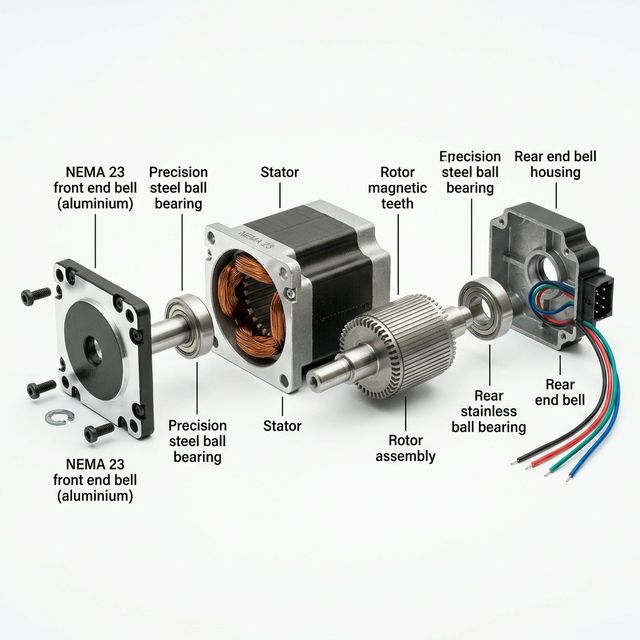
OEM Customization Checklist for NEMA 23 Orders
A clear RFQ package can cut weeks of back-and-forth. Use this template before you contact the factory.
1) Define non-negotiable specs
Send must-have values first: target torque window, speed window, current class, shaft geometry, cable/connector standard, and ingress protection expectation.
If you include only marketing terms like high torque or high speed, sample rounds will expand and risk of mismatch rises.
2) Align validation method with factory
Agree on test condition baseline before sample build: voltage, current limit, controller pulse mode, load inertia, and acceptance criteria.
This prevents a common dispute where factory test passes but customer-side commissioning fails under a different setup.
3) Plan supply continuity before pilot lot
For repeated B2B orders, ask for winding code traceability, connector BOM lock, and controlled change process.
A simple change-notice agreement helps avoid silent substitutions during scale-up.
4) Lock commercial terms tied to engineering risk
Define MOQ by configuration, not by family name. Custom shaft, cable, or connector often creates a different MOQ and lead-time profile than standard parts.
Ask for split lead-time visibility: engineering confirmation, sample build, validation iteration, and mass-production window should be shown separately.
Include an engineering change clause in quotation terms so approved samples cannot drift silently during repeated orders.
5) Build a sample validation matrix before approving MP
Test rows should include torque-speed point checks, no-step-loss acceleration profile, thermal soak result, connector pull/fit verification, and cable flex behavior if moving harness is used.
Each row needs pass criteria, test owner, and evidence format. Without this matrix, teams often approve by impression instead of measurable performance.
Keep one reference controller and one reference driver setup for all sample rounds to avoid apples-to-oranges comparisons.
6) RFQ email structure buyers can copy
Subject example: NEMA 23 OEM RFQ - shaft custom + cable harness - annual qty. Body should include target torque/RPM, current class, shaft drawing, connector spec, validation criteria, expected annual quantity, and required delivery milestone.
When needed, add one line for preferred communication: quote-only first or engineering discussion first. This reduces back-and-forth and shortens quote cycle.
OEM Deep Dive: Preventing Sample Loops and Drift
These frameworks help procurement and engineering teams align on custom requirements, schedule risk, and change-control discipline.
Sample-loop time cost
loop_days = rounds x average_feedback_cycle_days
One missing field in RFQ can add 5 to 10 days repeatedly.
Customization cost per unit
delta_unit_cost = (tooling_nre / annual_qty) + added_bom_delta
Use this before choosing low-volume custom connector options.
RFQ completeness index
completeness = validated_required_fields / total_required_fields
Target 1.0 before sample authorization to reduce churn.
RFQ completeness by critical field
The weakest fields usually predict where sample rounds get stuck.
OEM timeline with critical path
Separating engineering, validation, and pilot windows keeps launch plans realistic.
Customization decision matrix
Use this matrix when deciding which features should be custom now versus deferred.
| Customization item | Buyer value | Factory impact | Risk if unspecified | Recommended lock timing |
|---|---|---|---|---|
| Shaft profile + tolerance | Ensures coupling fit and concentricity | Fixture and machining setup change | Assembly scrap and rework | Before first sample release |
| Connector family + pinout | Reduces wiring and field error | Harness BOM branch increases | Polarity mismatch in FAT/SAT | At RFQ stage |
| Cable flex specification | Improves machine uptime | Material sourcing and test duration | Early cable failure in motion axis | Before pilot lot build |
Change-control SLA table for repeated orders
A simple SLA prevents silent drift between approved sample and mass shipments.
| Change type | Minimum notice | Required revalidation | Buyer response rule |
|---|---|---|---|
| Winding material or process | 60 days | Torque-speed + thermal soak rerun | Stop shipment until signed approval |
| Connector or harness supplier shift | 45 days | Pinout verification + pull test | Approve with PPAP evidence |
| Shaft machining revision | 30 days | Dimensional report on 30 pcs | Run coupling fit audit |
Buyer Resources
Download editable templates and review external references to validate selection and OEM decisions.
Ready-to-use downloads
Download OEM lock checklist (CSV)
Cross-functional lock table for custom shaft, harness, quality, and change control.
Download OEM RFQ template (TXT)
Structured OEM inquiry draft for faster quote and fewer sample loops.
Citable references
IATF 16949 Overview
Source: IATF Global Oversight
Quality-system reference when discussing change control and repeat order consistency.
Open referenceNEMA Standards Catalog
Source: NEMA
Supports framework-level requirements for standardization and specification language.
Open referenceStepper Motor Technology Basics
Source: Oriental Motor
Useful for defining OEM validation points around torque-speed and operating windows.
Open referenceSupply Chain and Operations Resources
Source: APICS
Operational planning reference for MOQ, lead time split, and repeat-order control.
Open referenceOEM parameter lock table
Use this lock table in your RFQ so engineering and purchasing stay aligned.
| Field | Example input | Why it matters |
|---|---|---|
| Shaft geometry and tolerance | 8 mm keyed shaft, chamfer, runout <=0.02 mm | Prevents coupling mismatch and assembly scrap. |
| Connector family and pinout | JST-VH 4P, pin order A+ A- B+ B- | Eliminates polarity and harness rework issues. |
| Cable construction and flex life | 4-core shielded, 2 million bend cycles | Links electrical reliability to machine motion duty. |
| Compliance and insulation class | Class B insulation, RoHS + REACH declaration | Avoids certification delay during customer audit. |
| Packaging and label traceability | Laser lot code + carton label with revision | Supports incoming inspection and failure tracing. |
| Engineering change notification rule | Written notice 60 days before material/process change | Prevents silent drift between approved sample and MP. |
| Pilot lot validation matrix | Torque, thermal, fit, cable pull test with pass criteria | Makes sample approval evidence-based, not subjective. |
| MOQ by customization set | MOQ 300 pcs for custom shaft + custom cable | Improves purchasing forecast and cost planning. |
Copyable OEM RFQ email template
Use this OEM format to reduce sample loops and quote faster.
Subject
OEM NEMA 23 RFQ - [Custom Shaft/Cable] - [Project]
Body
Hello Nema23Motor sales and engineering team,

Please quote an OEM NEMA 23 configuration:
- Core performance: [torque range], [speed range], [phase current class].
- Custom mechanics: shaft drawing [file/rev], tolerance [spec].
- Connector/cable: [connector family], cable [length/spec], pinout [doc].
- Validation matrix owner: [team], acceptance criteria [list].
- Change control: notify before any winding/connector/process change.
- Commercial: MOQ by config, sample lead time, MP lead time, annual qty.

Please include any DFM feedback that may reduce risk or lead time.
Buyer FAQs
What causes most OEM sample loops on NEMA 23 programs?
Most loops come from incomplete RFQ packages: missing shaft tolerance, missing connector pinout, and unclear validation ownership or pass criteria.
Is MOQ fixed across all custom options?
Usually no. MOQ should be quoted by configuration set because custom shaft, cable, and connector combinations change material planning and production setup.
What change-control clause should buyers request?
Request written notice before any winding, connector, insulation, or process change. This protects consistency between approved samples and mass production lots.
Related articles
NEMA 23 Market Update (2026-W19): U.S. Tariff Corrections Shift Landed-Cost Math Before the EU Machinery Gate
One-line decision: do not release U.S.-bound NEMA 23 POs in 2026-W19 unless landed-cost sheets include post-2026-04-06 tariff assumptions, FR 2026-08297 correction checks, and a dated EU compliance owner.
Driver Current and Voltage Mistakes on NEMA 23 Projects
Most field failures are not motor defects. They are current-setting, pulse-interface, and thermal-validation mistakes.
Next step for your project
If you want a concrete recommendation for your axis, share target torque, RPM, current class, and planned volume.